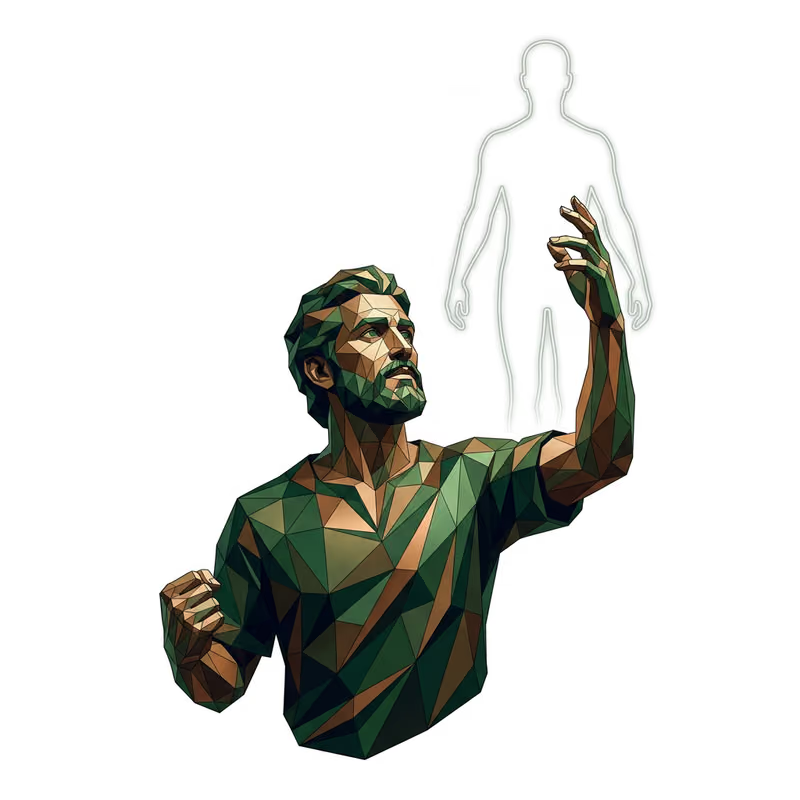

One-liner: A father who was absent, unavailable, or never truly engaged leaves a specific developmental gap that the adult keeps trying to fill, often through status, and defends with aggression.
Also known as / related terms: James Herzog’s “father hunger”; paternal deprivation; narcissistic deformation; the unmet need for paternal recognition; disordered aggression regulation.
This entry uses clinical language, but it is not a diagnosis and not a substitute for therapy, medical, or legal advice. It is here so you can recognize a pattern and protect yourself, never so you can label a colleague.
What it is
The hunger never gets fed.
Psychoanalyst James Herzog introduced the term “father hunger” in his clinical work with children and adults. He developed it at length in his 2001 book Father Hunger: Explorations with Adults and Children and sharpened it in his 2004 paper “Father Hunger and Narcissistic Deformation” in The Psychoanalytic Quarterly.
His central observation is that fathers are not interchangeable with mothers in a child’s development, they play a distinct role, and one of that role’s key functions is helping the child learn to regulate and modulate aggression, to feel powerful and assertive without being flooded or destructive.
When the father is physically absent, emotionally unavailable, or present but disengaged, the child is left with an unmet hunger for paternal recognition and, crucially, without the internal scaffolding that a steady father-relationship helps build. Herzog links this specifically to what he calls “narcissistic deformation,” a warping of the developing self around the gap, marked by a fragile sense of worth and poorly regulated aggression.
The child organizes their inner world around an absence, and the absence keeps shaping them long after childhood ends: the adult carries both a chronic, often unconscious hunger to finally be seen and validated by an authority figure, and a difficulty handling the aggressive feelings that competition, criticism, and challenge stir up.
This is the developmental counterpart, on the paternal side, to the object-relations material about mothers elsewhere in this category. It also speaks directly to the founder’s original observation: a person who was not respected or acknowledged by their father, once they finally reach a position that confers the respect they were denied, may guard it with a ferocity that only makes sense once you know how long and how deep the hunger ran.
How it shows up later
In the adult, father hunger often shows up as an outsized craving for the approval of senior figures combined with a brittle, aggressive response to anyone who threatens their standing.
Land the person in a role with real authority, the very recognition they were starved of, and the same unmet hunger can make them unable to tolerate a subordinate who is talented, independent, or unimpressed, because that person reactivates the original wound of not being seen. It is a common developmental thread underneath the Malignant Narcissism and Corporate/Successful Psychopath profiles, where the need for status and the readiness to attack those who threaten it travel together.
Why they do it
The hunger to finally be recognized never got fed at the source, so it drives behavior indirectly for a lifetime, and because the father-relationship that normally teaches aggression-regulation was missing, the aggression that competition and challenge provoke comes out poorly modulated, defensive, and disproportionate rather than measured.
How to protect yourself
You cannot fill the gap, and you were never meant to try.
- Notice if someone’s need for a particular senior person’s approval seems to override their judgment, that dynamic is often where the wound is loudest and where you are most likely to be sacrificed to it.
- Do not try to become the affirming figure they never had. It is not a role you can fill, and attempting it usually deepens the dependency and the eventual resentment.
- Keep your competence visible to more than one authority figure, so that being resented by one insecure superior does not quietly become your whole story.
- Understanding the origin is for your clarity, not their exemption: an unmet childhood need explains the behavior without making its adult cost yours to pay.
Cross-links: Malignant Narcissism, Covert/Vulnerable Narcissism, Narcissistic Rage and the Fragile Self, Corporate/Successful Psychopath.
Sources
Primary research and original sources
- Herzog, J. M. (2004). “Father Hunger and Narcissistic Deformation.” The Psychoanalytic Quarterly, 73(4), 893-914 (PubMed), accessible abstract confirming authors, journal, and the paper’s core argument on paternal availability, aggression modulation, and narcissistic pathology.
- Same paper, Wiley Online Library, canonical publisher record (blocks automated access, but the paper is real).
Background and general explainers
- Father hunger and narcissistic deformation, Semantic Scholar, scholarly index record with abstract and references, and pointer to the 2001 book that developed the concept.
Label note: This is a psychoanalytic/clinical construct developed by a named clinician (James Herzog) from decades of case material, not a peer-reviewed epidemiological finding and not a DSM diagnosis. “Father hunger” names a developmental pattern; it is not a claim that any specific adult’s behavior can be traced with certainty to their father. Treat it as clinically informed explanation, not a label to assign.
- The Absent Father: Physically gone, or present but never really engaged.
- The Unfed Hunger: A chronic, often unconscious craving to finally be seen by an authority figure.
- The Climb: Status pursued as the recognition that was denied, and guarded with disproportionate aggression.
- Being Truly Seen: Never arrives. No title fills the original gap.
The hunger never gets fed. It just finds a bigger stage to go unfed on.