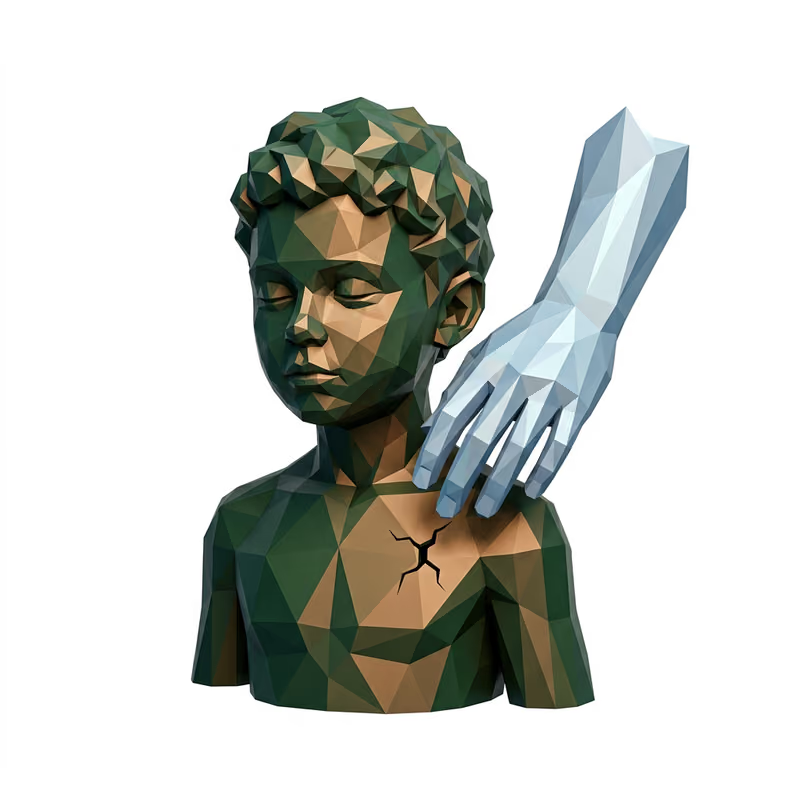

One-liner: The specific finding that low-quality, cold, or irregular parenting is measurably linked to the manipulative, callous, entitled traits this guide’s Dark Triad entry describes.
Also known as / related terms: Developmental antecedents of the Dark Triad; parental care and Machiavellianism, narcissism, psychopathy; “the making of Darth Vader”; low-warmth / high-control parenting; parental rejection and antisociality.
What it is
Cold early care leaves a measurable mark.
The guide’s Dark Triad entry describes the adult traits, narcissism, Machiavellianism, and psychopathy, but says little about where they come from. A body of empirical research addresses exactly that.
In a widely cited 2014 study memorably titled “The Making of Darth Vader: Parent-Child Care and the Dark Triad,” researchers Peter Jonason, Minna Lyons, and Emily Bethell examined 352 people and found that the Dark Triad traits related meaningfully to remembered parental care and attachment quality, with Machiavellianism the most sensitive to low-quality or irregular parental care, and effects for narcissism and psychopathy that were often specific to which parent and which component of the trait was involved.
This dovetails with a broader literature: studies repeatedly find that people high in psychopathy recall childhoods marked by parental rejection, neglect, inconsistent or harsh punishment, and inadequate supervision, and that harsh parenting, psychological aggression, and coldness predict higher Dark Triad and dark-personality scores in adulthood.
A 2022 study of German adolescents, for example, modeled how adverse parental rearing interacts with Dark Triad traits and propensity for violence. The consistent thread is that cold, rejecting, inconsistent, or controlling early care is not just correlated with adult unhappiness.
It is specifically linked to the emergence of the manipulative and callous trait cluster that does the most damage in workplaces. Genetics and temperament matter too, and no study claims parenting is the whole story, but the developmental contribution is real and measured.
How it shows up later
This is the most direct causal bridge in the category: it connects straight to the Dark Triad entry.
The adult who reads people with cold accuracy, manipulates without the friction of guilt, and treats colleagues as instruments is, in a meaningful fraction of cases, expressing a strategy that took root in a childhood where warmth was unreliable and relationships were something to be managed rather than trusted. The callousness that looks like a fixed personality often has a developmental history behind it.
Why they do it
When early care teaches a child that closeness is unsafe or transactional, a manipulative, self-protective, low-empathy strategy can become the rational adaptation, and it hardens into a stable adult trait. What functions later as exploitation frequently began as a survival response to an environment that did not reward trust.
How to protect yourself
Understanding the root explains the trait; it never lowers the guard you still need.
- Let the developmental picture lower your self-blame, not your defenses: the coldness was likely shaped long before you, and it is still not safe to rely on.
- Do not treat “they had a hard childhood” as a reason to extend trust the person’s current behavior has not earned; origin explains the trait. It does not neutralize it.
- Keep protecting yourself exactly as the Dark Triad entry advises, documentation, corroboration, guarded disclosure. Understanding the root does not change the countermeasures.
- Remember that most people from cold or harsh childhoods do not develop these traits, so the origin is an explanation for the pattern, never a way to profile anyone by their past.
Cross-links: Dark Triad, Corporate/Successful Psychopath, Insecure and Disorganized Attachment, The ACE Study.
Sources
Primary research and original sources
- Jonason, P. K., Lyons, M., & Bethell, E. (2014). “The Making of Darth Vader: Parent-Child Care and the Dark Triad.” Personality and Individual Differences, 67, 30-34, full-text PDF, the original study linking parental care and attachment to the Dark Triad traits.
- Same paper, canonical DOI record, publisher citation link for the study.
- Nowak et al. (2022). “What makes a violent mind? The interplay of parental rearing, dark triad personality traits and propensity for violence,” PMC, peer-reviewed study modeling parental rearing alongside Dark Triad traits.
Background and general explainers
- Harsh parenting in childhood linked to dark personality traits in adulthood, PsyPost, accessible summary of research connecting psychological aggression and severe punishment in childhood to adult dark-personality traits.
Label note: This is established, peer-reviewed empirical personality research. It reports measured associations between recalled parenting and adult trait scores, not a diagnostic pathway for any individual. Effects are real but partial, temperament and genetics also contribute, and the great majority of people with difficult childhoods never develop Dark Triad traits.
- Cold, Irregular Early Care: Not one event; a pattern of care that was inconsistent, harsh, or withheld.
- Machiavellianism: The trait most sensitive to cold care; relationships become things to manage.
- Psychopathy: Tracks rejection, neglect, and harsh, inconsistent punishment.
- Narcissism: Effects depend on which parent, and which side of the trait.
Most people from cold childhoods never develop these traits. The link is real, not a destiny.